We're Not Even Imagining 1% of What the Space Industry Will Unlock
What the iPhone got right about platform inflections — and why cattle collars matter more than you think. We are in the 2007 moment for the space economy, and almost everyone is viewing it through the wrong lens.
By Nathan Whigham
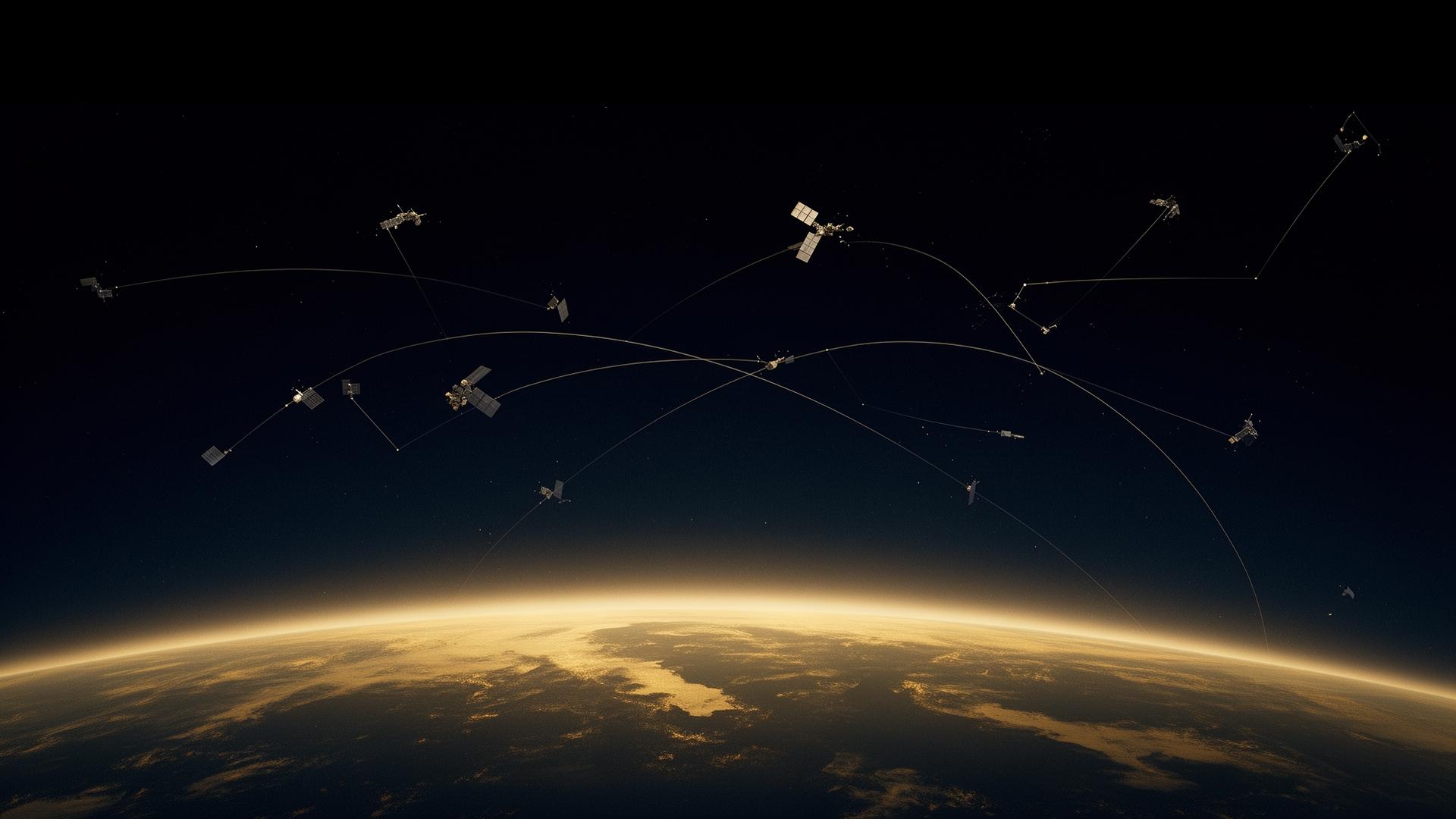
What the iPhone got right about platform inflections — and why cattle collars matter more than you think.
I bought my first iPhone on the second day they were available, at the Apple store in the Grove in Los Angeles. I remember being genuinely excited about one specific thing: I would finally be able to watch videos on my phone. That was the whole pitch in my head. A small screen with video playback was, to 2007 Nate, the killer app.
If you had told me that the iPhone in my pocket would within five years enable Uber — that a stranger driving a Toyota Camry would pick me up curbside at LAX because I tapped a button on a glass rectangle — I would have laughed at you. Not because it was unlikely. Because the concept didn't even exist as a category to imagine. Uber required a precise stack of capabilities to be cheap, distributed, and reliable simultaneously: GPS, cellular data, instant compute, secure payments, always-on connectivity, and crucially, a phone that was already in everyone's pocket and not just the pocket of early adopters. None of those preconditions existed at consumer scale before the iPhone era. Once all of them existed simultaneously, Uber became inevitable. But almost nobody saw it coming.
Look at the articles written about the iPhone in 2007 and 2008. Read what the technology press, the financial analysts, the early-adopter bloggers, the venture capital community said the device would unlock. You will find essentially zero predictions of Uber, of Instagram, of TikTok, of DoorDash, of Robinhood, of Cash App, of the entire mobile gig economy, of remote work transformation, of the way the dating-app market reshaped a generation. The predictions you will find are about apps that make existing phone tasks more elegant. Better email. Better calendars. Better games. Better web browsing. The most ambitious predictions — and there were a few — were about mobile commerce displacing some fraction of online commerce. Almost nobody, in 2007, predicted the iPhone's true second-order consequence: that it would enable entire categories of business that did not previously exist.
That misunderstanding is the single most important pattern to internalize about platform inflections. When you reduce the cost of a foundational infrastructure layer by an order of magnitude — and then make that layer ubiquitous — you don't just enable the businesses you can predict. You enable an entire generation of businesses that nobody can predict. The ones that get talked about in advance are usually wrong, or at least incomplete. The ones that actually emerge are weirder, more specific, more vertical, more lateral, and ultimately collectively bigger than the conventional wisdom imagines.
We are now in exactly that moment for the space industry. And almost everyone is viewing it through the same lens as the iPhone in 2007.
The space-industry version of the 2007 iPhone lens
When people talk about the future space economy today, the predictions are almost identical to the iPhone predictions of 2007 in their structure: they describe extensions of existing categories. The forecasts you read about — in industry reports, analyst presentations, conference keynotes — focus on the businesses that are already legible. In-space manufacturing of fiber optics and pharmaceuticals. Lunar resource extraction. Orbital tourism and hospitality. Solar power generation in space. Asteroid mining.
All of those are real. Some of them will become enormous industries. But they share the same defining characteristic of the 2007 predictions about the iPhone: they are the obvious second-order consequences. They are extensions of existing categories using new infrastructure. They are predictable.
What is not predictable — and what will collectively be far larger than the predictable categories — is the third-order wave. The wave of businesses that cannot exist yet because the precondition stack doesn't exist yet. The Ubers of the space economy. The companies whose business models presuppose a specific combination of cheap launch, global direct-to-device satellite connectivity, low-power IoT-from-space hardware, and persistent orbital infrastructure that has only recently begun to be available at commercial scale.
Most of those companies have not been founded yet. Many of them will be founded by people who have no current connection to the space industry, in the same way that Uber was not founded by anyone with a meaningful connection to the smartphone industry. They will use space the way Uber used smartphones — as a piece of infrastructure they take for granted, not as the central object of their business.
How cattle collars fit into this
Earlier this month, a New Zealand-based company called Halter announced that its solar-powered livestock collars now connect directly to SpaceX's Starlink constellation. The collars manage herd location via virtual fencing — when a cow approaches a digitally drawn boundary, the collar beeps; when the cow turns away, the beeping stops. They collect roughly six thousand data points per minute on each animal's health and behavior. They replace the physical fences, herding dogs, and human cowboys that have constituted cattle ranching infrastructure for most of human history. The story was covered as a technology curiosity on YouTube here: Starlink Just Changed Ranching Forever.
While this is great for cattle ranchers, here's the real significance: the Halter case is one of the first publicly visible examples that a small, low-power, solar-charged endpoint device can maintain a reliable direct-to-satellite connection at consumer-scale economics. Until now, Starlink connected things that could carry heavy antennas and dedicated power: houses, ships, airliners, military vehicles. The Halter integration proves something different. It proves that the connectivity layer is now extending down to objects the size of a soda can, powered by a solar panel the size of a credit card, operating in the middle of nowhere.
That capability is not specifically about cattle. It is about every remote, low-power, intermittently-connected object on planet Earth. Autonomous wildfire sensors deployed across millions of acres of backcountry forest. Pipeline integrity monitors stretched across thousands of miles of Arctic terrain. Wildlife tracking tags on endangered species in regions that have never had communications infrastructure. Maritime container telemetry that reports continuously without depending on port-side data uploads. Distributed atmospheric sensors that turn the planet into a single instrument. Agricultural soil monitors. Border security sensors. Disaster response beacons. The list does not end. Many of these use cases are not currently practical, not because the technology is missing, but because the economics haven't worked. That has changed.
Halter is to space what the original iPhone was to mobile. It is the first commercial proof that the foundational capability exists at a price point that supports broad deployment.
The next thousand companies that build on top of that capability will look nothing like Halter. They will be weirder. They will be more specific. They will be in industries that have nothing to do with space at first glance. And most of them have not been founded yet.
What the iPhone actually got right
The iPhone succeeded as a platform not because Apple correctly predicted Uber. It succeeded because the device put a specific combination of capabilities into the hands of a billion people, and then largely got out of the way and let other people figure out what to do with that combination. The App Store was an accident. It wasn't part of the original iPhone launch in 2007 — it took an additional year of internal Apple resistance before Steve Jobs reluctantly allowed third-party developers to build native applications. The single most important platform decision in modern computing history was made grudgingly, after the fact, and only after external pressure made the original closed model untenable.
What space is undergoing now is structurally identical. The infrastructure layer is being built — by SpaceX with Falcon and Starship, by SpaceX with Starlink, by Rocket Lab and Stoke and Relativity, by Amazon's Kuiper, by Iridium and Globalstar's direct-to-cell evolutions, by AST SpaceMobile, by the lunar landing services consortium, by the commercial space stations that will host the next generation of orbital research. Cost-per-kilogram to low Earth orbit, which has been falling for a decade, is about to fall again by an order of magnitude when Starship becomes routinely operational. Persistent global connectivity is going from “concept” to “deployed” inside a 36-month window. Direct-to-device satellite communication, which has been promised for thirty years, is now being commercially demonstrated.
When you put those pieces together, you do not get a future in which the space economy is dominated by orbital tourism and asteroid mining. You get a future in which space is a substrate — an enabling infrastructure layer that supports business models that don't have “space” in their pitch deck and that we cannot yet name.
The most exciting time to be in the room
I have been spending an increasing amount of my professional attention on the space industry over the last several years, and the question I get asked most often is some version of “what should I do to get exposure to space?” The conventional answer is to invest in the legible categories — the rocket companies, the satellite manufacturers, the launch providers, the tourism plays. Those are fine. Some of them will be excellent investments. But they are not where the largest value will be created.
The largest value will be created by the unimagined companies that have not yet been founded. Companies whose entire business model presupposes a piece of space infrastructure that, today, either does not exist or is too expensive to use at scale. Those companies will be built by people who treat space the way Uber's founders treated the iPhone: as a piece of plumbing they didn't have to build, a layer of capability they could simply assume.
The best way to position yourself for that future is not to predict which specific companies will emerge. It is to be in the room where the infrastructure is being built, the capital is being structured, the legal frameworks are being negotiated, the standards are being set. The people who will benefit most from the next decade of the space economy are not necessarily the ones who pick the right rocket company stock. They are the ones who become structurally connected to the platform itself.
We are imagining maybe one percent of what this is going to unlock. Maybe less. That is the most exciting framing I can give you. We are in the 2007 moment. The cattle collar is one of the first weird examples. There will be thousands more. Most of them will surprise us. All of them, collectively, will rewrite the assumptions of more industries than any of us currently expect.
The work between now and then is to pay attention, to stay in the room, and to recognize that the most interesting space businesses haven't been invented yet.
Nathan Whigham is the founder of EN Capital, a private capital advisory firm working across commercial real estate, the space industry, and renewable energy. He holds a graduate certificate in Space Law from the University of Mississippi School of Law and has spoken at industry venues including Ascend Las Vegas.
Structuring a transaction?
EN Capital advises on capital placement, project finance, and M&A across North America and the Caribbean.